Golf has not always appeared welcoming from the outside, with a reputation for elitism among non-golfers. But during the pandemic, that shifted as golf’s popularity surged and the sport gained millions of new players. With that shift has come a new, counterculture golf movement that is making the sport more accessible and relatable to people of all backgrounds.
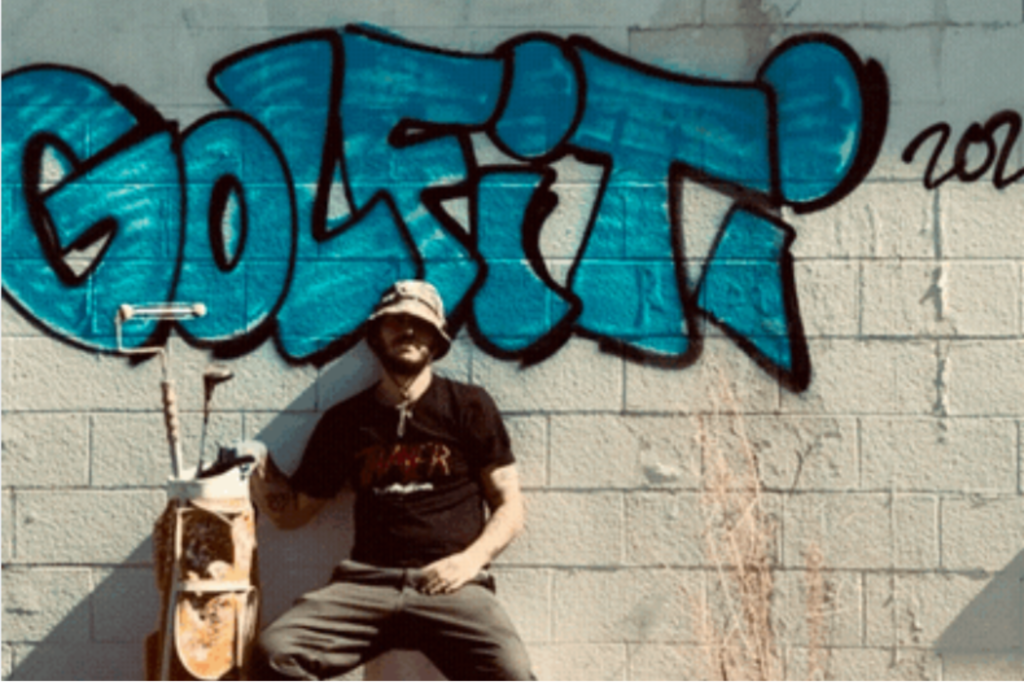
One person at the forefront of the counterculture golf movement is Max McGuigan, founder of Golfiti, a golf gear and clothing brand that blends elements of both golf and graffiti. Fairway to Green’s Zanny Merullo sat down with Max to learn more.
Zanny Merullo: How did you get into art and graffiti?
Max McGuigan: I’ve been doing art my whole life, and then around 14 started doing graffiti in Providence. I never stopped, and now it’s led to all these opportunities that are much more positive than I had growing up.
20 years down the line, graffiti is much more accepted. Even my mom never thought it would lead to this—I’ve been arrested a bunch of times and things weren’t looking great, so now she’s like: “This is so cool that you found a way to incorporate this into something positive.” She really came full-circle seeing what I’m doing now in a legal way and getting compensated for it.
Z.M.: What drew you to graffiti in the first place?
M.M.: Graffiti and skateboarding really go hand-in-hand. A lot of skate spots growing up had graffiti. So before I even started writing graffiti, just growing up in Providence I was always traveling through the city and would see graffiti and just gravitated towards it. Being a troublemaker and a rebellious kid, this was already in my wheelhouse. I wanted to go against the grain.
In graffiti, there’s composition, there’s color, there’s design… People just see a tag and they’re like “that’s not art,” but it’s an artform.
Z.M. How did you get into golf?
M.M.: During COVID, after 10 years off from skateboarding, I went back to skateboarding but now was taller and heavier and I was a little more goofy on my skateboard than when I was a little kid, so it didn’t take long to tear my ACL. This was kind of towards the tail end of COVID, but I had one buddy who was like: “You’re done skateboarding. Come play golf.”
I’m a lefty and we found one lefty six iron, so that’s what I teed off with, hit my second shot with, and then I would putt right-handed. I learned how to hit that one club early on, and I don’t know if there’s much better feeling than a flush iron shot. So I was like “Ohh, I see why you play. That felt really good.”
And then the camaraderie on the golf course…I didn’t expect that. That resonated with me because it’s so similar to skateboarding in that it’s a very individual sport but you do it with a group of friends. I’m not skating against my friends, it’s me against myself. And it’s the same with graffiti—I might do a whole wall with my buddies, but it’s just my piece that I’m focusing on. So golf was right in that same hemisphere.
Z.M. How did Golfiti come about?
M.M.: That all happened back in Rhode Island, then I moved out here [to Colorado]. My fiancée got into vet school and her schedule is very structured. I had to get a job, and I hadn’t worked in a long time—before it was mural painting and everything off the books.
When I got out here, I thought: “If I’m going to get a job, it’s going to be around art and golf.” I felt the obsession coming along. I looked at the golf courses but they weren’t hiring, so then I went to Dick’s Sporting Goods and saw they were hiring for the golf department.
I got in there and that’s what kind of prompted me to start to do my own golf designs, because all the shirts all look the same to me. Like, if you remove the left chest logo, I would think they’re all the same company. And the whole country club aesthetic—whitewashed, elitist—it’s not my look. I didn’t grow up with that and nobody in my family plays golf. But I saw kids coming in [to Dick’s] who had tattoos like me and looked different, like not your average golfer… It wasn’t just old white men, it was people from all walks of life.
Z.M.: What was the first product you made?
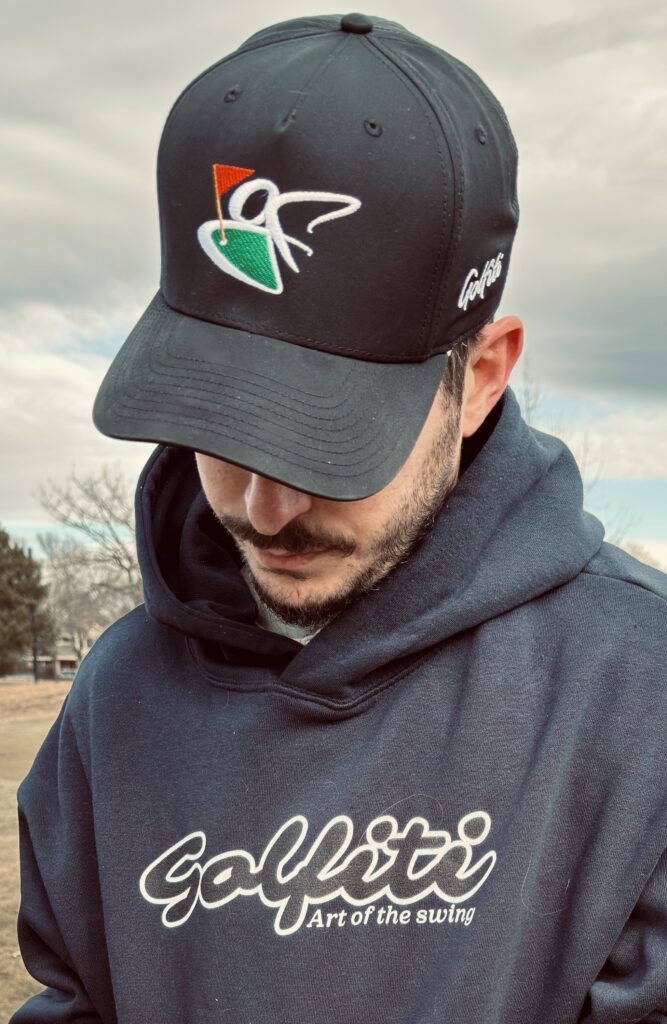
M.M.: I started with hats because every golfer wants a good hat. Kids were coming in and they didn’t want just the regular Titleist hat. So I started drawing and came up with the name. It was one of those lightbulb moments. I knew I had the name right then and there—Golf and Graffiti. Golfiti, boom.
The whole culture and attitude behind [golf] I didn’t really like, so it’s like how do I shift the narrative? Let me make something that caters to kids like me, so they feel included. The biggest compliments I’ve gotten are: “I don’t play golf, but if I did I’d wear this.” Or “I didn’t know golfers were wearing this. This is me.”
That was two years ago now. Since then, I’ve got the website up, got Instagram going. This is the first time I’ve had Instagram, because the whole point of graffiti is discretion and the mystique behind it… But now with this I need to be on Instagram. People can’t support me if they don’t know what I’m doing.
Z.M.: Can you take me through your process from design to production?
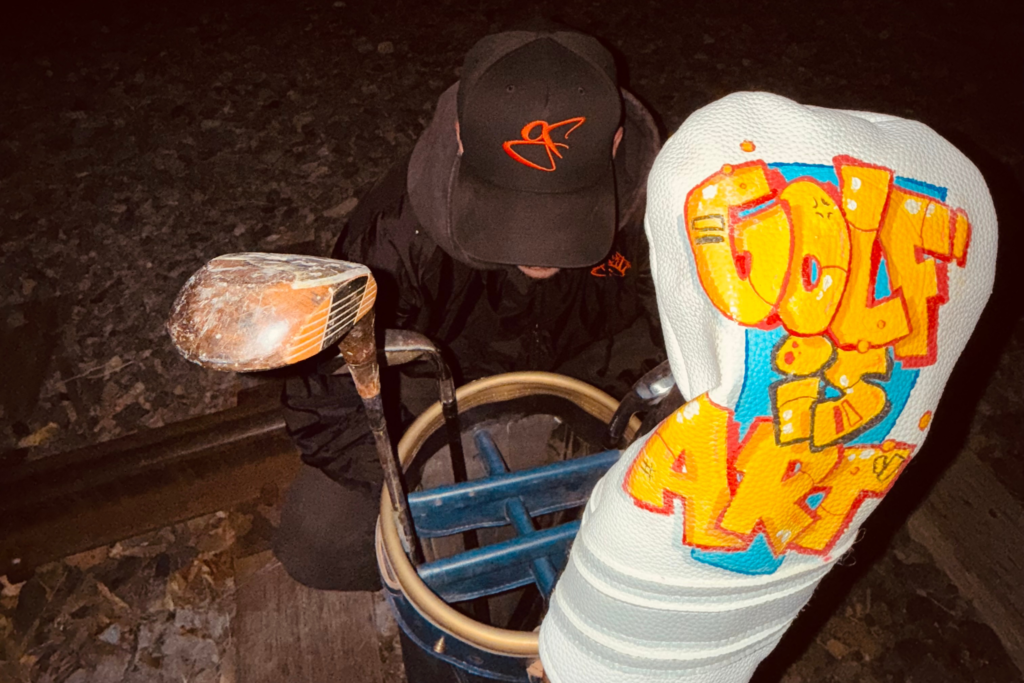
M.M.: Everything starts on pen and paper. Or before that, just brainstorming. And then I’ll digitize it so I can easily change things around.
When I first started, I probably did six months of designs in a week, I was just so excited. I was drawing everything. Then reaching out to embroiderers here in town, then I talked to people overseas to try and get the right price points. I draw it myself so I’m very particular with how I want everything to look. As an artist, I’m very involved. I had to sift through a couple different places and went to a guy locally here and got it all printed out.
Then it was reaching out to different manufacturers and seeing what’s the best process, whether it’s screen printing or embroidery. I did a bunch of sampling and all of this market research first because everyone has a hat—I have 30 hats, but I wear like the same two hats because of how they fit. I wanted to spend a few more dollars and get a good quality product so people actually wore it.
Z.M.: What have been your biggest challenges?
M.M.: There’s a lot of self-doubt that goes into it. Just being a creative person in general, I doubt myself. I’m like this sucks, I’m wasting my time, I should get a real job. All these thoughts creep into my mind and you have to power through and your vision has to be stronger than the doubt.
Every round of golf I play, I bring hats with me, and every round I sell at least one, maybe a couple. I’ll walk to the driving range and just ask if I can talk to people. A lot of people look at me like I’m crazy, but business is done on the golf course and some people will be like: “Yeah, Max, keep going.”
Working with people and ignoring the noise has been a challenge. I don’t think anyone’s going to care about it as much as I do. There’s a lot of lip service that goes on when people see you have motion and they want to jump in on it. You want to surround yourself with as many like-minded people as possible. People who are going to uplift you and propel you and motivate you to keep going.
Social media has definitely been a challenge. I won’t do the trending stuff. If it doesn’t fit Golfiti, if it’s corny, I’m not doing it. That’s not the identity of the brand, that’s not me. I’m not going to start compromising my integrity or my artistic vision because this is a trending sound on Instagram or whatever.
Z.M.: What’s next? What are your plans and goals for Golfiti?
M.M.: With all the AI stuff going on, I really drive home the point that this is hand-drawn. This is from my brain to you, this is a piece of me. There are 25 years of experience in this hat.
I’d like to do equipment. Gloves, golf bags…I think that would be super fun. But for now, the hats and shirts have been an easy way for me to get it out there.
I want to continue to get my stuff in pro shops. That adds such a level of legitimacy to what I’m doing. It’s big for morale—seeing it on the shelf just does something for me.
I’m moving back to Rhode Island in June, so I’ll pick up there what I did here and just go talk to people. I talked to 20 golf courses and I got three or four to carry Golfiti. Some of those older pro shop guys… As soon as I say ‘graffiti’ they don’t want to hear it. But that’s why I lean into that this isn’t for everyone.
I’m not going to sugarcoat it—I’ve been arrested many times. I love golf. Say what you want, but we both just made par on this hole. [Golf] is kind of the equalizer. Once you get on the golf course, you can either hit a seven iron or you can’t.