
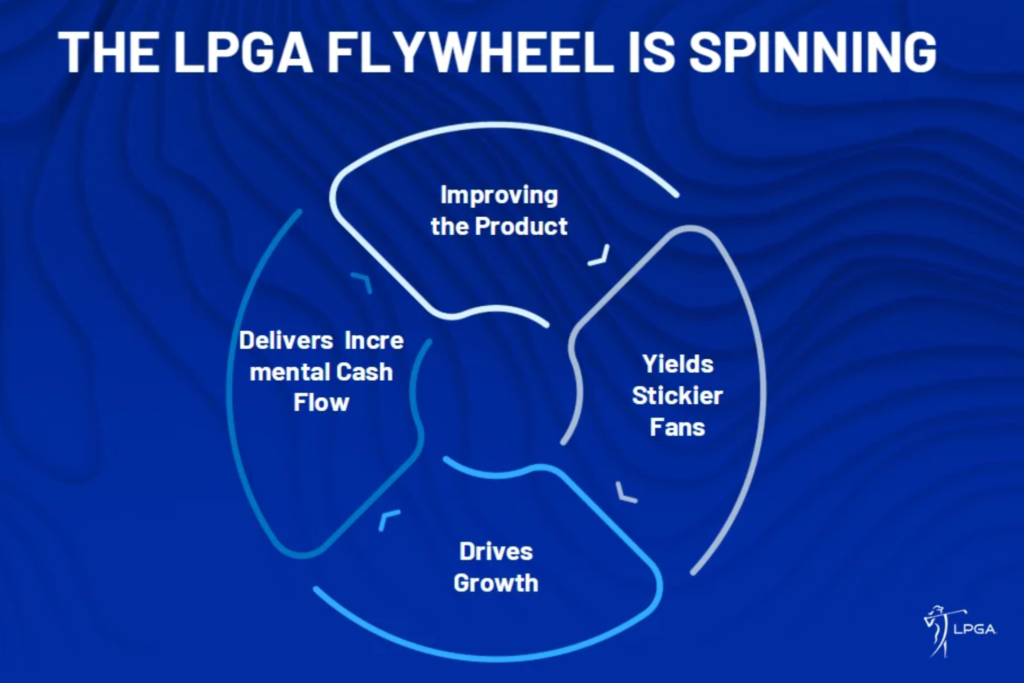
The LPGA Tour continues to trend upwards at the helm of commissioner Craig Kessler. Last year, he presented a flywheel to demonstrate what he hoped to accomplish in his first season in this role. This year, we learned the results.
“If I had to characterize how I feel about the state of the LPGA in a sentence, it’s that I think the LPGA is very strong,” said Kessler. “This was a foundational year for us in many ways. We were aggressive where we could be and have wins to show for it. It was also a year that was eye-opening in many ways and helped us understand where we still have more work to do, and we are very clear-eyed about where we have more work to do.”
Where the LPGA Tour Started in 2026
To recap, the LPGA Tour poured into five buckets in 2026:
- Broadcast
- Schedule
- Building Stars
- TV Rights
- Internal Talent
The goal was – and still is – to perpetuate this flywheel: improve the product to yield stickier fans, which will drive growth, which will deliver positive, incremental cash flow. This will then be invested back into the product.
Where the LPGA Tour Is Finishing in 2026
Here’s what happened so far, supported by data:
- Major viewership increased 21% year-over-year, with female viewers up 10%. Every round was live.
- The LPGA Tour saved 12,000 miles of travel in their new schedule (16% decrease).
- More than 115 players dedicated time for content creation and storytelling.
- TV windows will continue to improve in 2027, with 50% more weekend windows following PGA Tour coverage coming. The WTGL also debuted this fall.
Internal talent wasn’t discussed as much this time around, though Kessler did mention the 200 staff members of the tour putting in hours of hard work to bring these results to life. Chad Coleman, whose hiring announcement was made here last year, was in the CMO role for less than a season before stepping down for family reasons; Taylor Strick and Ryan Ogle split the role and responsibilities internally.
Reasons to Be Hopeful About Women’s Golf
Below is what stood out to us from Kessler’s update. Fairway to Green’s Kelly Okun had a chance to ask Kessler about the biggest lessons learned this season and how those will show up in the coming years.
“One, where we have opportunity to strike while the iron is hot. The Nanea Cup would be a great example,” said Kessler. “What we’ve done with The Standard is a great example. When people are excited to get involved, take advantage of the moment.
“I think on the flipside, I’m not a very patient person, but I’ve learned that sometimes patience is important. I have pushed this team so hard and they have responded in ways that I only could have hoped for, and I am so, so deeply proud of them. We have 200 employees. PGA Tour has over 1,000 putting on a similar number of events. What I’m constantly trying to do is strike the balance between pushing hard when the opportunity is there, but also finding patience, because we have to play the long game.”
Intentional, Data-driven Programming
A self-proclaimed data nerd, Kessler and his team recently hired a Duke Ph.D. to analyze how to bring more eyes to the LPGA Tour.
“What we can now understand in more detail than ever before, what are the factors that drive tune-in or viewership, and we can dimensionalize the importance of each of those factors. If you look at the broadcast windows we had this year, the regression analysis would actually tell you perhaps we should have been down this year. So to be down 7 percent tells us something right is happening. What we’re doing is working,” said Kessler.
A unique insight that is bringing more viewership to the LPGA Tour is giving fans the opportunity play the golf courses on the schedule on Trackman ahead of the events.
“Since Monday, we’ve had 50,000 fans around the world play Tiburón,” said Kessler. “They’ve played a replica version of the CME [Group] Tour Championship on TrackMan simulators, and what we know from surveying these fans is they’re roughly 75 percent more likely to actually watch an LPGA event if they’d played a version of this golf course on a simulator.”
Ball Position Data Incoming
Data in women’s golf has been severely lacking. The LPGA Tour began their ball position data last week at The ANNIKA and will continue it through the CME Group Tour Championship before officially locking it in as an option for fans and media in 2027.
“You want to know every shot that every player hits, distance from the pin, greens in regulation, fairways in regulation. What that ball position data allows us to do is tell incredible stories in the broadcast and in our app. It gives fans the ability to compare how good one athlete is to another, and frankly, the LPGA has never been able to afford to make an investment like this.”
New Pace of Play Policy
Last week, the LPGA Tour announced a player-made pace of play policy that is quite strict. Here’s a breakdown of the new rules and consequences:
- Seconds allowed per shot decreases from 70 to 60.
- Plus 1-5 seconds: immediate fine
- Plus 6-15 seconds: one-stroke penalty + fine
- Plus 16 or more seconds: two-stroke penalty + fine
- If a player reaches 35 timed holes (used to be 40), they will be fined.
“Our fans have spoken and frankly our athletes have spoken too,” said Kessler. “They want to see us play faster. [The policy is] very aggressive. This is a place where the LPGA wants to lead from the front.”
Social Is Taking the Storytelling Lead
“It’s the best year we’ve ever had on social. We had over a billion impressions as of last week, which is 23 percent ahead of where we were this time last year,” said Kessler.
It’s a Movement, Not a Moment
A sentiment shared by many who have believed in women’s sports since the very beginning, we are seeing the LPGA Tour create a product brands are willing to invest in as a true strategy, not just as an act of goodwill.
“Our partners are doubling down, and what really excites me about this is the companies who actually know us best are the ones who are growing their investment,” said Kessler. “And these partners are buying in in really big ways. Five partners mid-season raised purses. And just to say a word about purses – at the start of the ’26 we announced $131 million in prize money. In ’27 we’ll compete for at least $147 million in prize money. That’s very meaningful growth in a short period of time. By the way, it’s being powered in many ways by blue chip names that are joining the LPGA for the first time.”
Tradition Matters
In addition to bringing new venues to the schedule, the LPGA Tour is reviving some beloved ones in 2027 as well. The Classic in Corning, N.Y., is one of those favorites.
WTGL Adds Another Opportunity to Showcase Personalities
The WTGL launched last week, and it’s already feeling like the WNBA. The fashion walk-ups, the camaraderie and support, the emotions. Even the game’s legends are coming out of retirement to be a part of it. There’s so much to watch here that will lead younger fans to the LPGA Tour.
Kessler shared why he thinks the WTGL is succeeding already:
“Number one, the format. Number two, and maybe it’s related to the format, but it’s how our athletes are taking advantage of that format. Number three is the demographic that it’s bringing in. Anything that brings in a younger audience is exactly what we need.”
One part of Kessler’s legacy as LPGA Commissioner that is sure to be cemented is his clarity, consistency and dedication to the tour’s mission to “empower, inspire, and advance opportunities for girls and women both on and off the golf course.” Seeing what he presented last year and learning the results today, we see great improvements in women’s golf behind the scenes and are looking forward to seeing the fruits of their labor at LPGA Tour events in years to come when more girls are coming out to cheer on their idols.
However, the work isn’t done yet. In the words of Kessler, “We’ve got 75 more years of history to write.”