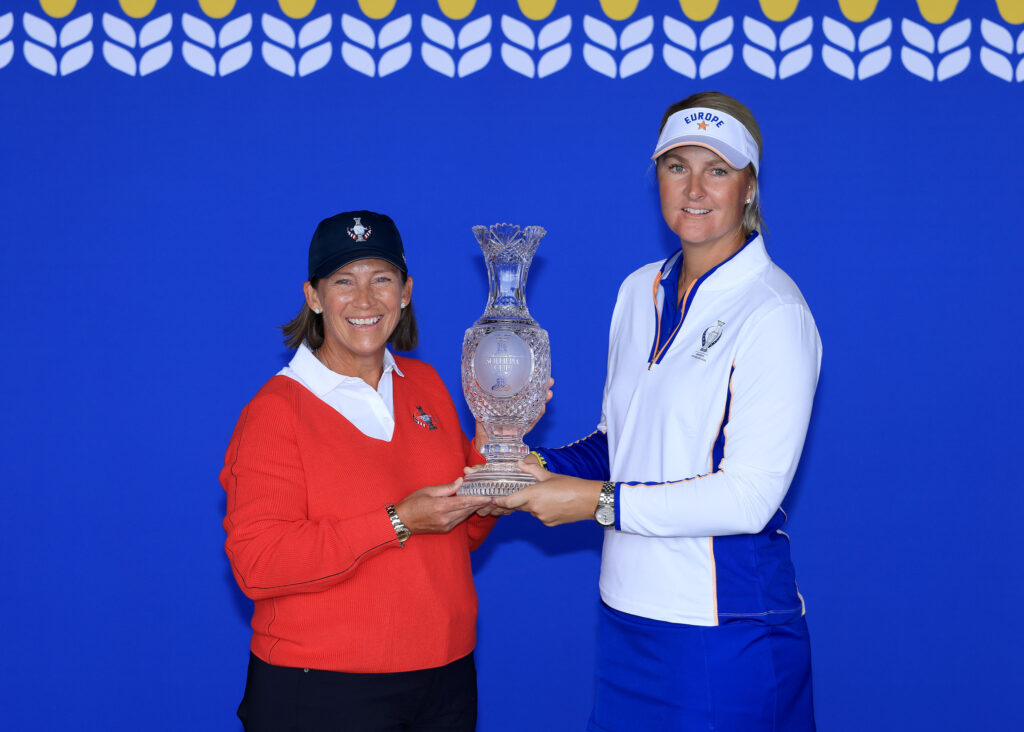
A Solheim Cup captain is unlike any other leader in sports. She is guiding a team that did not exist a week or two before the competition. And that competition? It only lasts three days. (And happens every two years—usually with a different captain at the helm).
Yet, a Solheim Cup captain carries many of the same leadership qualities that we witness in successful CEOs: experience, intuition, communication skills and smart hires, to name a few. And one of them will find the traditional definition of success – the trophy – today.
When U.S. Team Captain Angela Stanford stepped up to the mic for her press conference, she reminded me of another important element of leadership: selflessness.
“See, I would say I want them to win for each other,” said Stanford. “Seeing that, if we leave this week and we are, you know, blessed enough and lucky enough to be holding the cup, I think that feeling that they’re going to have, I mean I’ve won two in Europe, and there’s just not another feeling like it. So I want that for them. Like we know, like it feels so good… They need to remember that they’re playing for each other because I just want them to have that feeling.”
Her drive to ensure everyone on her team is enjoying themselves and competing at their best in turn inspires her vice captains and players to win for her. Stanford’s mission-driven focus and genuine care for her players as humans and competitors elevated the team’s performance levels. We see that in successful businesses all the time. Stanford has built a winning culture in a matter of days.
European Team Captain Anna Nordqvist brought a different perspective to light. She said she has never been in a leadership position before. Golf is such an individual sport, and while high school and college teams exist, that doesn’t mean every golfer gets to lead them.
While Nordqvist claims she has never led before—and that is true in that she has never officially led this team—we want to give her more credit. Not only has she competed in the Solheim Cup nine times, she has also been a vice captain twice. She has learned leadership skills from those who have come before her and understands the dynamics of a team, especially one in such an intense competition. That experience breeds intuition, and her choice in vice captains allows her to continue growing in a supportive environment. While she may not view herself as a leader, her mentors clearly did and she has gleaned more than she has likely realized from her experiences and peers.
Stanford demonstrates strong culture and Nordqvist displays quiet confidence. Both of these traits are crucial to building a winning team.
That’s why Solheim Cup captaincy needs to be studied. These two captains, who have the competence and accomplishments to validate their role, are able to create a team environment that some CEOs fail to ever achieve.
Stanford and Nordqvist have entrepreneurial qualities that lead to their success off the golf course and—for one of them—on it this week. They know and leverage their strengths; they surround themselves with the best support system; they create the best future they can envision with the skills and ideas they have.
They prepare, but they also know when to act. Only half of their teams are selected through qualification—the other six players are chosen quickly and carefully the week or two ahead of the competition. The fact that the players, who are “doing” the work on the golf course each day, become known quantities at the last minute goes to show how much leadership development is done behind the scenes.
While the captains are hammering out the details in the present, they’re also passing their wisdom on to their vice captains, who may one day assume their place. And like their mentors have done for them, Stanford and Nordqvist are sharing their ideals while allowing their support system to develop their own leadership styles and philosophies.
Nordqvist and Vice Captain Caroline Hedwell mentioned they rode bikes in Amsterdam a year ago, and it seemed like the perfect metaphor for giving someone the opportunity to lead while still having her mentor by her side.
“I quickly learned that if you sit in the back, all you do is you sit there and cruise, so she was doing the hard work in the front,” Nordqvist said.
That “bike ride” sitting arrangement is also likely how Nordqvist learned to become a Solheim Cup captain from her predecessors, and while we’re sure she wasn’t leaving all the hard work to Hedwell, being hands-off as a leader from time to time is one of the best ways for your leadership team to grow into their own styles while still giving them support.
We don’t know who will win the cup today, but if we look beyond the traditional definitions of success – to the ones that are mattering more and more every day – both Solheim Cup captains are victorious. We’d hire either of them in a second.