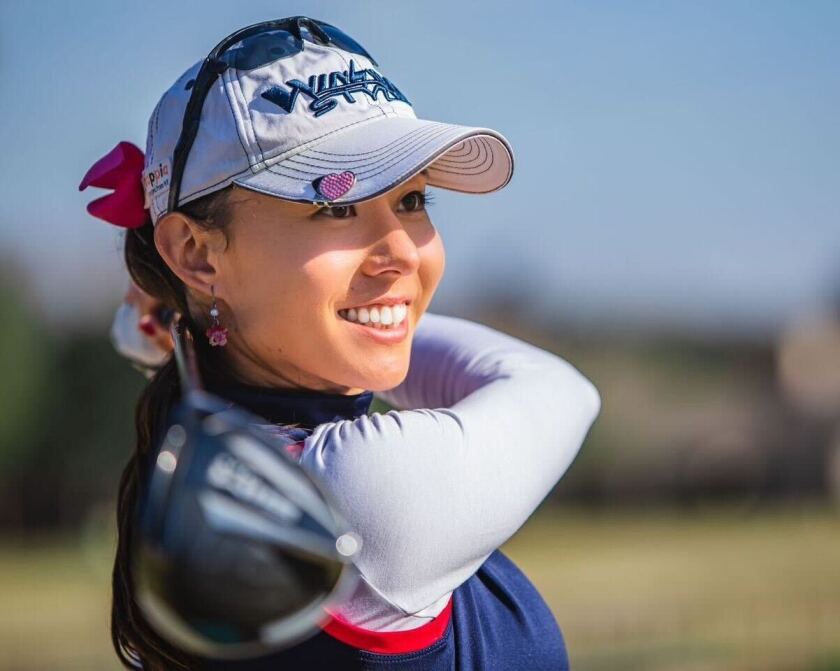
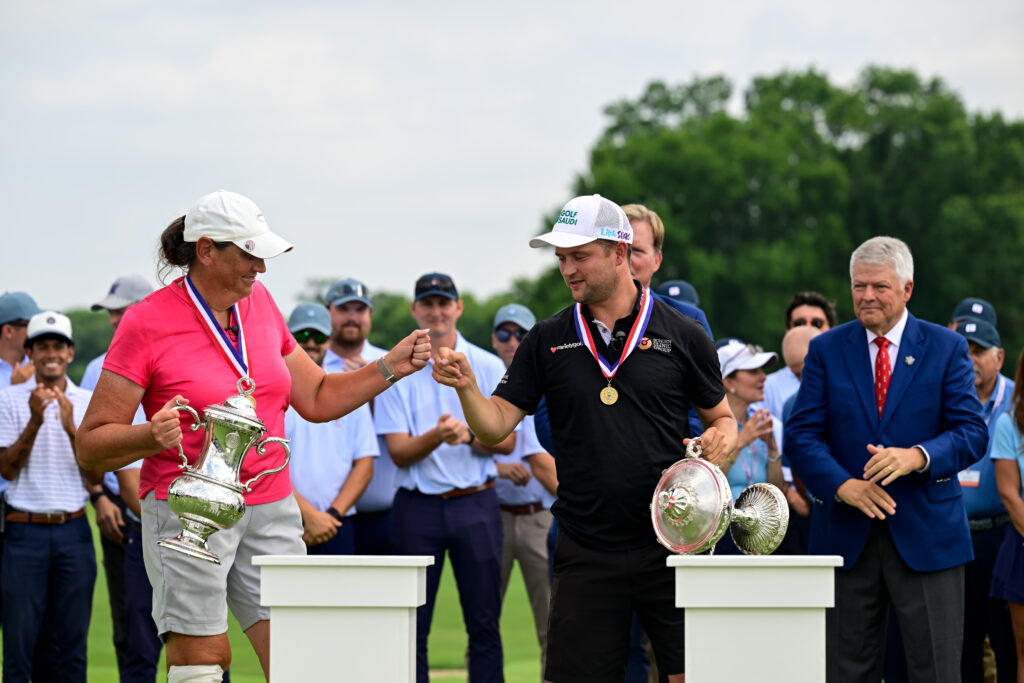
If you’ve been following the 2026 U.S. Adaptive Open this week, you’ve likely seen Kim Moore and Kipp Popert making their way to their third and fourth victories, respectively.
Moore’s momentum continued from the first round, never losing the lead. Sunyoung Kim and Bailey Bish came within a couple strokes of Moore, but her grit allowed her shoot her third 76 (+4) of the week and successfully defend her title. Moore has now won the inaugural U.S. Adaptive Open in 2022 and again in 2025 and 2026.
Kipp Popert earned his fourth U.S. Adaptive Open title in a row yesterday, running away with the event after shooting a 63 (-9) to secure his title. Last year, Popert shot a 61 (-11), so Popert was having fun during his final round trying to best himself.
What an example of shooting for the moon and landing among the stars – with this 63, Popert shot an impressive 18-under overall to win by 6 strokes over Simon Seungmin Lee, the only other male U.S. Adaptive Open champion in the history of the event.
Despite the same winners continuing to triumph, there were so many moments of hope and inspiration this week. The women saw their biggest field yet, with 26 players in 7 categories. Annie Hayes, who was the lone player in the Women’s Seated Players category, had an impressive chip-in eagle this week that hopefully inspired more girls and women to join her category next year.
On the men’s side, we saw Justin Carlock, who barely made it past qualifying, tie for the lead after the first day and ultimately finish in a tie for third in his first ever U.S. Adaptive Open.
These are just some of the stories that will keep these players coming back forever, but what stood out the most was the supportiveness of the adaptive community throughout the week.
Trillium Rose, the director of instruction at Woodmont Country Club, said it best. “Another great thing about this tournament is the camaraderie, and you realize how close these players are as people and as humans,” Rose said. “So many have missed the cut, and they’re out here watching the next day. You don’t see that very often.”
Popert later told Fairway to Green that he believes the adaptive community is the benchmark for golf. “ I feel like we set the standard, I hope, for golf to show that you can be really competitive,” he said. “You can be really trying to beat each other, but you can all be friends before and after, and I’m really proud of everyone here and how we act as a community. I’ve played able-bodied golf – I still play able-bodied golf – and I do believe we set the standard, so I’m really proud to be part of this community.”
Sure enough, players who missed the cut were following the leaders in their categories or cheering on their friends that they’ve met through this experience. Every single player who could stayed to watch their friends come in on the 18th green and then celebrated the winners more intimately during their own an award ceremony.
And the best part is? They’re always looking for more people to join them on the golf course.
After Kelly Gorman finished T9 and was eating lunch with her family, Ricky Reilly came over to introduce himself, welcome her to the community and congratulate her on a great first showing. They quickly realized they live near each other, so there’s no doubt they’ll be playing golf soon. Reilly also shared a list of adaptive golf tournaments curated by the U.S. Adaptive Golf Alliance (USAGA) and encouraged Gorman to continue playing throughout the year. The U.S. Adaptive Open has been an incredible step in giving the adaptive community a large stage, but it’s important to recognize so many other organizations have been stepping up to give these golfers opportunities year-round as well.
Another organization to take note of is AdapTee Golf. Many players befriended Andrew Mitchell this week, who is a golf coach for paraplegic players. Mitchell described AdapTee Golf, saying “It’s a version of swing-less golf. We use three different pieces of equipment so that anyone who has lost the ability for any reason to complete a swing path can get out and play from tee to green.”
For those that haven’t picked up a golf club yet, Moore summed it up best. “ Golf is so adaptable, and, you know, it’s, a game that we can all play,” she said. “And if you have the guts to go out there and just try, you might surprise yourself. Just give it a shot. You never know what’s going to happen, and you might end up one day out here playing and being a part of all this.”